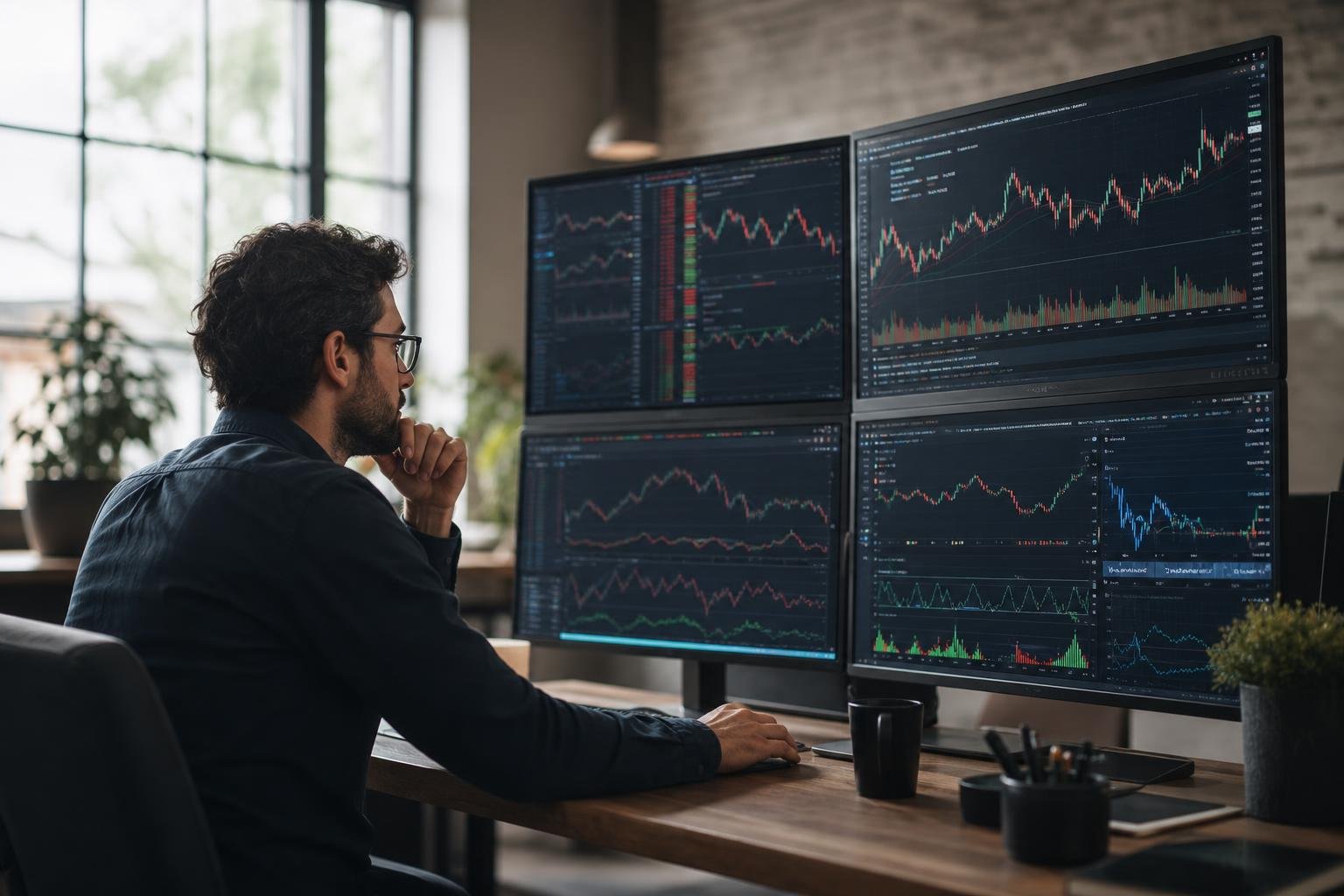
Crypto trading bot automation represents a significant development in the cryptocurrency trading landscape. These software tools interact with exchanges via APIs to execute trades automatically based on predefined strategies. This guide aims to provide a clear understanding of how crypto trading bots work, their benefits and potential pitfalls, common features, examples of automation workflows, and essential considerations for users seeking to incorporate automation into their trading activities.
For product-specific monitoring context, review the Gunbot Live dashboard and portfolio feature.
For related Gunbot Live context, review API key permissions for trading bots guide and Gunbot Live backtesting tools.
Table of Contents
- What crypto trading bots actually do
- Core criteria for choosing a trading bot
- The main risks traders underestimate
- Automation versus control
- Common automation workflows
- Security and operational considerations
- Where Gunbot fits as an example
- A practical selection checklist
What crypto trading bots actually do
A crypto trading bot operates by connecting to one or more cryptocurrency exchanges via API keys authorized by the user. It continuously monitors market data such as prices, volumes, and order books and executes buy or sell orders based on rules defined by the trader. Bots vary in design; some focus on strategies like grid trading, dollar-cost averaging (DCA), market making, arbitrage, or signal execution from external sources. Others support fully customizable strategy programming. Crucially, bots automate execution, not decision-making — the quality of outcomes depends on the underlying strategy and parameters set by the user.
Core criteria for choosing a trading bot
When selecting a crypto trading bot, traders should consider several important criteria to ensure the tool fits their needs:
- Strategy control: The ability to define, modify, and backtest trading strategies rather than being limited to fixed presets.
- Exchange support: Compatibility with the exchanges and trading pairs you intend to use.
- Backtesting and paper trading: backtesting tools that allow you to test strategies on historical data or simulated environments before risking real capital. Before using meaningful capital, compare what backtesting, paper trading, and limited live trading can actually validate.
- Risk controls: Mechanisms to limit position sizes, manage drawdowns, apply stop-loss rules, and control overall market exposure.
- Transparency: Clear visibility into why the bot executes trades, helping to understand performance and troubleshoot issues. For active operation, the live crypto trading bot dashboard checklist explains which balances, orders, fills, connection states, and risk warnings should remain visible while automation is running.
- Security: Robust API key management, avoidance of withdrawal permissions, IP whitelisting, and other safeguards to protect funds and credentials.
The main risks traders underestimate
Trading bots can amplify strengths and weaknesses alike. Common pitfalls traders may overlook include:
- Poor strategy parameters: Overfitting strategies to past data without considering real market variability can lead to poor live performance.
- Low-liquidity assets: Trading thinly traded pairs risks slippage and failed order execution.
- Exchange outages: Bots may react erratically if connectivity to exchanges is lost during volatile periods.
- Excessive leverage: Magnifies potential losses and the risk of liquidation.
A disciplined approach starts with small allocations, detailed logging of bot decisions, ongoing monitoring, and readiness for atypical markets.
Automation versus control
The central trade-off is between consistent, repeatable execution and discretionary human judgment. While manual traders can weigh complex contextual factors, they may hesitate or emotionalize decisions. Bots eliminate hesitation and enforce discipline by faithfully following coded rules—assuming those rules are sound. The optimal approach typically blends automated execution controlled by human-designed strategies, with continuous performance monitoring and manual intervention triggers where necessary.
Common automation workflows
Typical workflows available in crypto trading bot platforms include:
- Grid trading: Automatically placing buy and sell orders at set intervals around a price range to profit from market oscillations.
- Dollar-Cost Averaging (DCA): Spreading purchases over time to reduce entry price volatility.
- Market making: Posting both buy and sell limit orders to capture bid-ask spreads.
- Arbitrage: Exploiting price differences across exchanges or pairs.
- Signal execution: Autonomously trading based on external signals or technical indicators.
- Custom strategies: Coding bespoke logic using scripting or strategy builders.
Each workflow carries specific requirements and risk characteristics, necessitating understanding before deployment.
Security and operational considerations
Proper security practices are critical when operating trading bots:
- Use API keys restricted to trading only; disable withdrawal permissions.
- Apply IP whitelisting wherever supported by the exchange.
- Rotate API keys periodically and remove unused keys.
- Monitor logs and trade history for suspicious activity.
- Deploy bots on secure environments, preferably isolated from other internet services.
- Prepare for exchange downtime or API failures with disaster recovery and fallback planning.
Operational diligence reduces the risk of funds loss and unexpected behavior.
Where Gunbot fits as an example
Gunbot Live exemplifies crypto trading bot software designed for traders seeking configurable automation over black-box signal services. For an exchange-specific example, the Gunbot Live vs Binance trading bots comparison explains the difference between exchange-native automation and an independent bot workspace. It supports connection to numerous exchanges and allows users to craft or customize strategies, backtest performance, analyze risks, and monitor ongoing execution. While suitable for experienced users with a good understanding of their strategy, it shares fundamental evaluation criteria with all bots: verifying risk management, exchange support, testing workflows, usability, and security practices.
A practical selection checklist
Before choosing any crypto trading bot, define and document:
- Your trading strategy and parameters.
- Target exchange(s) and trading pairs.
- Maximum position size and capital allocation.
- Conditions that should trigger suspending the bot (market volatility, drawdown limits, etc.).
- Performance metrics to review regularly (win rate, drawdown, fees impact).
Evaluate candidate platforms for their ability to support these requirements with clarity and transparency. Convenience alone is not a substitute for suitable functionality and robust risk management.
FAQ
What is crypto trading bot automation?
Crypto trading bot automation refers to software tools that connect to crypto exchanges and execute trades automatically according to rules, signals or strategies configured by the trader.
Are crypto trading bots profitable?
A bot is not profitable by itself. Results depend on the strategy, market conditions, fees, slippage, risk controls and how carefully the trader tests and monitors the setup.
What permissions should an exchange API key have?
In most trading-bot setups, API keys should allow trading but not withdrawals. Traders should also use exchange security settings, IP restrictions where available and regular key rotation.
For forensic review after an event, inspect a recorded bot decision with Gunbot Replay and compare the market move with the saved bot context.