
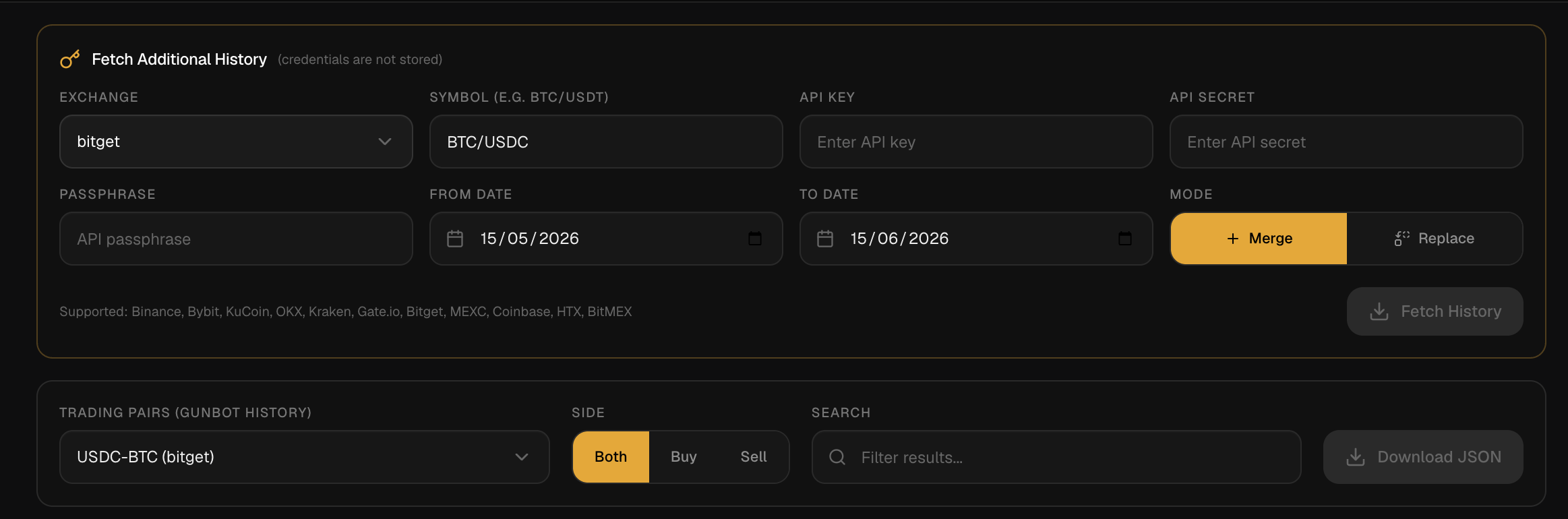
Trading history helps you inspect fills, order history, pair-specific activity, and historical trade records. It supports strategy review, support, tax preparation, disaster recovery, and factual analysis by keeping what actually happened close to charts, statistics, and dashboard state.
What This Feature Does
Order history gives you the evidence behind a run. When the connected setup provides the data, you can narrow the view by pair, side, exchange, and trade detail to understand what the bot actually did instead of relying on memory or summary numbers.
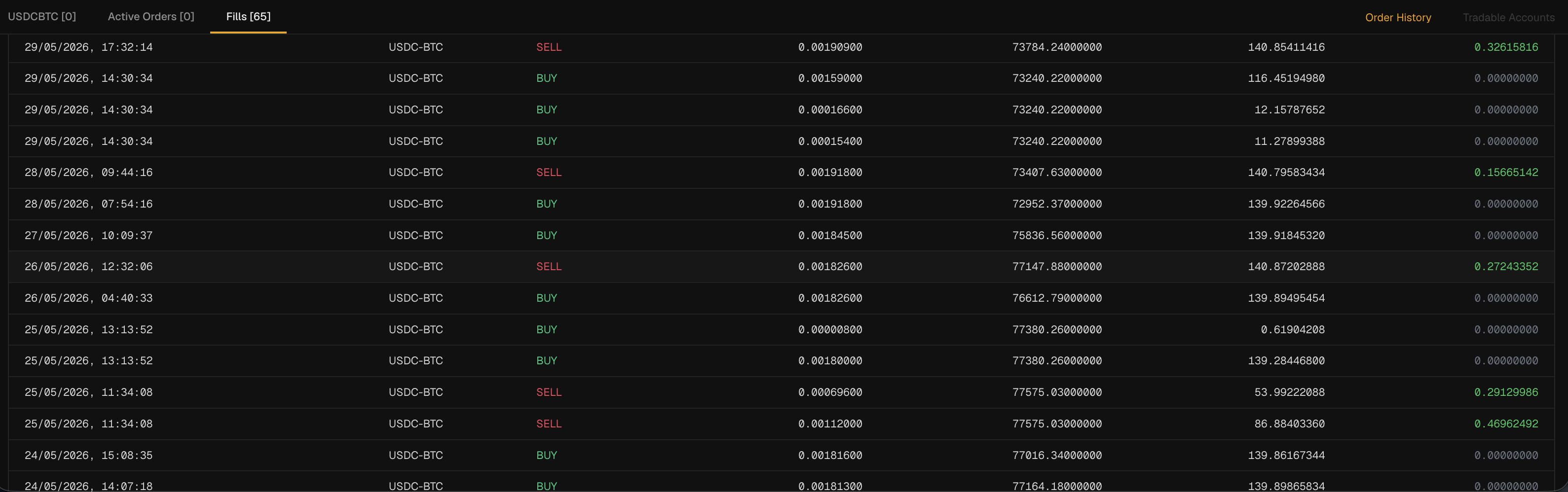
Example Workflow
You select a pair, check recent fills, compare buy and sell records, download relevant history, and use the ledger to understand realized results and strategy behavior.
Limitations
The limits matter: History quality depends on exchange data, Gunbot records, pair naming, and import/export consistency. Missing or damaged history may require recovery workflows.
Trading Reality
It gives Gunbot a browser workspace for monitoring, strategy work, backtesting, risk review, history, and exchange-connected operations. These pages explain what the product does. Your account data stays on your local trading bot, behind login.
Operational Limits
The dashboard depends on the connected Gunbot instance, the exchange API, and the network between them. It can make problems easier to notice, but it does not remove market risk or take responsibility away from you: exchange permissions, strategy settings, open orders, and capital allocation still need your review.
Plain Definition
Trading history is the factual record of what happened: buys, sells, fills, order IDs, timestamps, prices, amounts, pair names, exchange detail, and realized results. It is the evidence layer behind dashboards, statistics, recovery, JSON exports, and support investigations.
Pair-Specific History Matters
When you review USDC-XRP, you should not have to sift through USDC-ETH, BTC-USDT, or unrelated markets. Pair-specific history reduces confusion, makes downloads cleaner, and prevents support or tax workflows from mixing unrelated trades.
What Clean History Should Preserve
Clean history should preserve enough context to explain each trade later: exchange, market type, Gunbot pair name, exchange symbol, side, timestamp, price, amount, quote value, order or fill IDs when available, fees, realized PnL when calculable, and whether the record came from local history, exchange fetch, manual import, or recovery.
History Review Checklist
Before fetching or replacing history, confirm the selected pair and exchange, use the symbol format expected by the exchange API, respect exchange request-window limits, keep pair-specific exports scoped to the problem, and compare recovered records with existing local history before overwriting anything.
FAQ
Can history be filtered by pair?
The intended workflow is pair specific review so you can inspect the selected market instead of mixing unrelated pairs.
Is trading history the same as tax reporting?
No. Trading history is raw trading records. Tax treatment depends on jurisdiction and should be reviewed with a qualified professional.
Why can exchange symbol parsing break history recovery?
Gunbot pair notation and exchange notation are not always identical. A pair shown as USDC-XRP in Gunbot may need a different symbol format for Binance, Bitget, Bybit, or another exchange API.
Why should downloaded JSON contain only the selected pair?
You often share downloads for support or accounting. Including unrelated pairs exposes unnecessary trading data and makes analysis harder.
Last updated: